Is Female Submission Feminist?: Kink, Power, and Agency in Secretary (2002)
- Marnie Scott
- Mar 18
- 5 min read

Secretary (Steven Shainberg, 2002) was described by The New York Times as “a small groundbreaking comedy, … a contemporary Cinderella story with a kink and a wink.” I first watched the film a few months ago, with the idea of it being a soft BDSM movie depicting a secretary’s sexual discovery. Frequently framed as a dark romantic comedy or a progressive depiction of dominant–submissive (DS) relationships through a female lens, Secretary has been praised for its exploration of female sexual desire and kink within a mainstream cinematic context.
I understand the overall appeal of this movie to a female audience. It is sexy, aesthetically balanced, and has a wonderful soundtrack (I’m Your Man by Leonard Cohen!). James Spader and Maggie Gyllenhaal give an excellent performance, and there isn’t a dull moment throughout its 111-minute runtime. I thoroughly enjoyed my viewing experience during my first few watches. It provides a digestible version of BDSM, enjoyable for a mainstream audience. However, upon further analysis, I found some issues with this film that made it difficult to move past. Was Shainberg more interested in creating a shock value rom-com, or actually depicting the discourse around feminist experiences with kink and BDSM?
While dominant–submissive and sadomasochistic relationships are not inherently antifeminist, their feminist validity depends on how agency and power are represented. Through its conflation of submission with psychological vulnerability and institutional authority, I believe Secretary ultimately fails as a depiction of feminist kink culture, despite its surface-level portrayal of consensual female desire and discovery.

Secretary follows Lee Holloway (Maggie Gyllenhaal), a young woman recently released from psychiatric hospitalization due to a history of self-harm, as she searches for purpose and stability. She accepts a secretary position at the office of E. Edward Grey (James Spader), a reserved and socially withdrawn attorney. Lee struggles with minor typing errors, and Grey’s response to these mistakes escalates into a sadomasochistic (SM) sexual relationship in which punishment becomes eroticized.
As Lee develops romantic feelings, Grey responds with increasing discomfort and self-loathing, coming to a head in the form of a sexual encounter followed by her sudden firing. After briefly attempting a conventional relationship and engagement with a high school flame, Lee ultimately returns to Grey’s office and submits herself to an endurance-based command, remaining still for several days despite public scrutiny and family intervention. Grey observes her from a distance before reclaiming her, a moment the film presents as both romantic and liberating. This conclusion positions submission as proof of devotion, collapsing consent, suffering, and desire.
Secretary was originally written by Mary Gaitskill in 1988 in a collection of short stories titled the Black Letters. This short story was then adapted into a screenplay by Erin Cressida Wilson. Wilson’s original screenplay took an inherently more feminist approach, arguing for female agency and exploring submission as a part of their own sexual desire. It creates a discourse about whether DS and SM relationships can be feminist, or if we are just conforming to traditional gender roles. This has been a subject of psychofeminist discussion for quite some time, with differing feminist viewpoints on DS and SM relationships as a whole. “From a radical feminist approach, BDSM is viewed as violence against women, as something to educate and fight against. From a postcolonial feminist approach to understanding BDSM, … it is problematic for feminists to reach the conclusion that SM is not a feminist practice without first undertaking a world-travelling approach to the issue… feminists can examine their own culture, search for parallels between BDSM and other acceptable activities, and recognize the hegemonic positioning that often happens in representations of BDSM. From a sex-critical approach… individuals are encouraged to critically assess all forms of sexuality and related ideologies, and to look beyond the binary of freedom of choice vs. lack of ability to choose.” (Meeker, C., McGill, C.M. & Rocco, T.S.) Depending on your personal viewpoint of feminism, DS and SM relationships can either be seen as reinscribing patriarchal values, or as something to reflect upon, asking about the why rather than the what.

With Secretary, director Shainberg moved away from Wilson’s screenplay and critical approach, resorting to a male fantasy romance trope we have seen regurgitated again and again in mainstream film. A key example of this is a scene where Lee is reverting back to her self-harming behaviours, and is caught by Grey. He uses his authority in their power dynamic to command Lee to never repeat these harmful behaviors, and for the rest of the film she complies. It is never brought up again, and she seems to be completely devoid of the urges that were a major factor in her life up until this point. The film leans into such an obnoxious stereotype, a mentally ill white woman being saved by the authoritative white man, healed of all scars, she comes to the realization that all she really needed in life was the man to take care of her. This scene creates ideas about mental illness in women, that she can be cured by any man willing to “control her”, completely devaluing any discourse on female sexual liberation the film was trying to pursue.
Jessica Benjamin discusses in her book The Bonds of Love: Psychoanalysis, Feminism, and Domination, “even the more sophisticated feminist thinkers frequently shy away from the analysis of submission, for fear that in admitting women’s participation in domination(/submission), the onus of responsibility with appear to shift from men to women, and the moral victory from women to men.” This speaks to a central tension within feminist theory: if women are understood as desiring submission, feminist discourse must confront the uncomfortable possibility that power operates not only through external oppression but also through internalized and relational dynamics. However, Benjamin does not argue that submission itself is regressive, rather she insists that avoiding its analysis prevents meaningful engagement with how desire, agency, and power are socially produced. In the context of Secretary, by framing Lee’s submission as a symptom of psychological damage rather than an autonomous erotic choice, Secretary sidesteps the deep feminist analysis and removes responsibility from patriarchal structures.
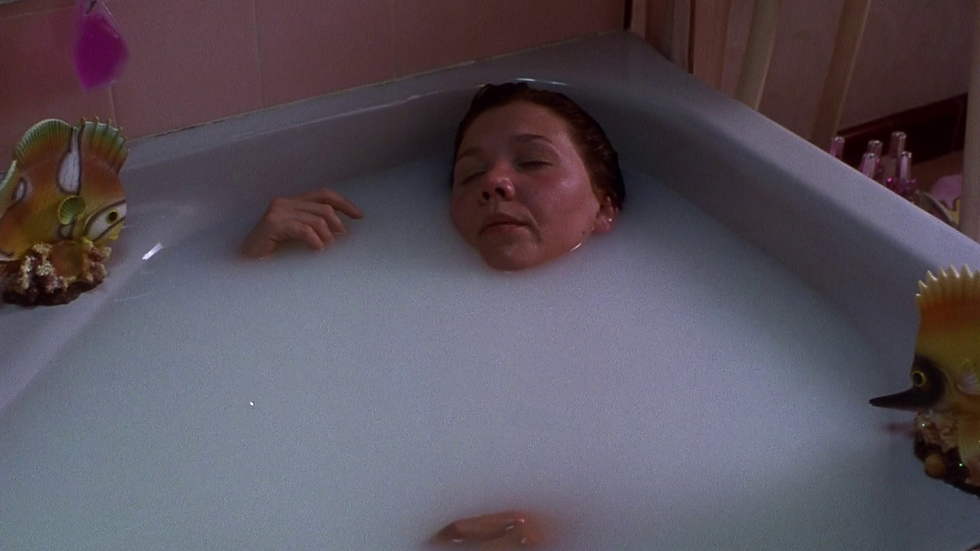
Secretary presents itself as a progressive exploration of female sexual desire, yet its portrayal of BDSM ultimately depends on conflating submission with mental illness and male authority in a Eurocentric and heteronormative worldview. While the film’s eroticism and assumed focus on female pleasure make it accessible and appealing to mainstream audiences, these surface-level qualities obscure a narrative that repeatedly undermines female agency. As feminist theorists caution, representations of domination that fail to interrogate power risk reinscribing the very hierarchies they claim to subvert. Shainberg’s direction moves away from the more ideologically complex questions raised by Wilson’s screenplay and feminist BDSM discourse, favoring instead a familiar male fantasy in which control and authority are framed as healing. In doing so, Secretary does not expand feminist understandings of kink but rather stabilizes patriarchal power through romance, leaving its depiction of BDSM less a site of sexual autonomy than a rearticulation of dominance disguised as liberation.
In Navigation of Feminist and Submissive Identity by Women in the BDSM Community: A Structured Literature Review (Meeker, C., McGill, C.M. & Rocco, T.S.)
The Bonds of Love: Psychoanalysis, Feminism, and Domination (Benjamin. J)

Somehow this is the article that made me realize Maggie Gyllenhaal is a Gyllenhaal (therefore related to Jake Gyllenhaal...don't ask how it took this long to realize they're siblings) but ALSO that she is the same woman who directed "The Bride!" this year.
This is a great read!